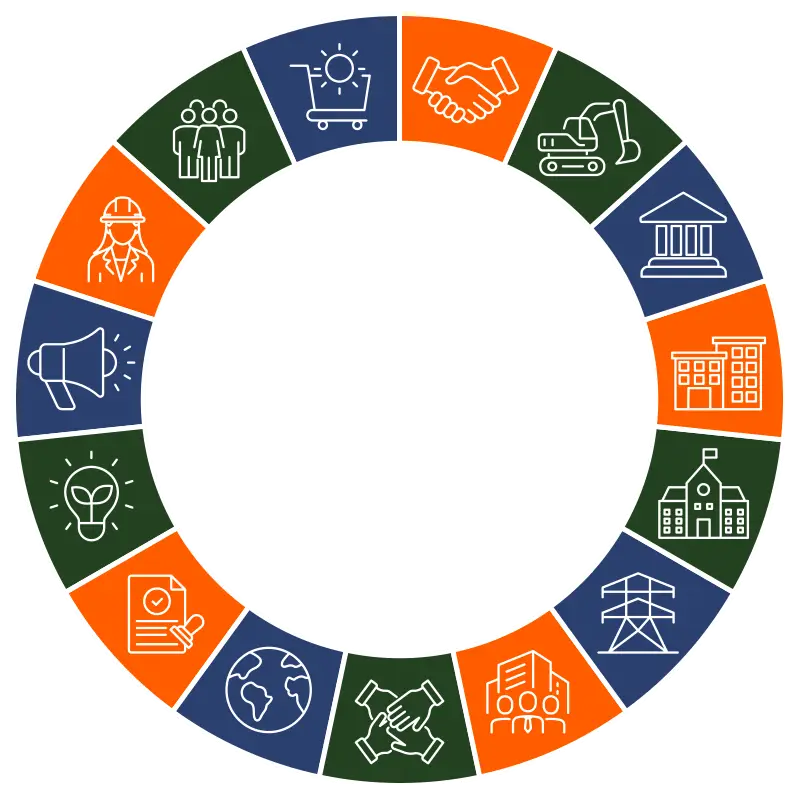
As part of its sustainability approach and in preparation for the double materiality analysis, LOTUS continued in 2025 the work initiated in 2024 to map its stakeholders and better understand the interactions within its ecosystem.
Carried out through internal multidisciplinary working groups, this approach aims to develop a comprehensive view of the relationships the company maintains with stakeholders who influence its activities or are influenced by them. It helps to strengthen our ability to understand mutual impacts, to act in a more informed way and to create, or co-create, value with our stakeholders from a regenerative perspective.
The mapping work identified 73 types of stakeholders involved throughout the life cycle of our projects or affected by our value chain. These actors have been grouped into 15 major stakeholder categories, notably suppliers, actors in the renewable energy sector, grid operators, financial institutions, local authorities, local communities, landowners, energy offtakers, service providers & sub-contractors, workers in the value chain, civil society organisations, NGOs, as well as the planet, considered a stakeholder in its own right in our regenerative approach.
This mapping serves as a structuring tool to guide dialogue with our stakeholders, identify priority issues and strengthen the integration of social, environmental and economic dimensions into our decisions.
Stakeholder / Services provided / Value created
Suppliers
• Development of partnerships rather than short-term contracts
• Promotion of environmental and ethical criteria in the supply chain – Achilles
Service providers & contractors
• Creation of economic activity
• Dissemination of best ESG and environmental practices
Financial institutions
• Investment opportunities
• Contribution to financial objectives
• Long-term value creation
Landowners
• Enhancing land value
• Preserving or enhancing the ecological functions of sites
• Additional revenue compatible with existing uses
Local authorities
• Contribution to local ecological transition objectives
• Enhancing the attractiveness and resilience of local areas
Grid operators
• Integration of solutions supporting the decarbonisation of the energy system
• Contribution to the resilience of energy infrastructure
• Cooperation for the optimisation of natural resources
Local communities
• Local economic benefits
• Preservation and enhancement of local natural heritage
• Raising awareness of environmental and biodiversity issues
Civil society / NGOs
• Dialogue and cooperation on ecological and societal issues
Planet
• Reducing pressures on the climate and ecosystems
• Preservation and restoration of biodiversity
Regulatory authorities
• Contribution to achieving national and European environmental objectives
• Compliance with environmental regulations
• Participation in the transition to a regenerative economy
Renewable energy sector
• Dissemination of environmental best practices
• Contribution to innovation in support of the ecological transition
• Strengthening sector standards
Media
• Provision of reliable information and sharing of expertise
• Promoting ecological initiatives
• Raising public awareness
Workers in the value chain
• Access to jobs contributing to the ecological transition
Employees
• Participation in projects with a positive impact
• Professional development in roles of sustainability
• Skills development related to sustainable development
Energy offtakers
• Access to energy with a positive environmental impact
• Reduction of their carbon and environmental footprint